PhotobucketPhotobucketPhotobucketPhotobucketPhotobucketPhotobucketPhotobucket

Tuesday, November 5, 2013

Vision realised: Avani Winery - Mornington Peninsula


Davendra and Shashi Singh are like many small-scale winemakers we have met on our travels. They have a passion for their craft and work hard to realise their vision. In their case, enough passion and daring to strike out beyond their successful restaurant businesses and take the considerable step of buying their own winery. This move occurred in 1998 when they purchased Wildcroft Estate, located south of Red Hill in the Mornington Peninsula. From 2000, Philip Jones of the Bass Phillip winery made Avani’s wines, with Shashi’s role in the winemaking process increasing from 2004 onwards.

Some reasonably young Syrah vines grafted onto older vines.
Halfway down the vineyard at the transition point from red to grey soil
As we walked with Shashi and Davendra through their winery and vineyard in early October, it was difficult not to be impressed by their enthusiasm, though also their boldness: Avani are possibly unique in the Mornington Peninsula (and if not, only one of a handful of wineries) to exclusively produce Syrah (quite rightly named given the style they aim for).
When asked about the exclusive production of Syrah, Shashi explained that following several vintages where Syrah stood out, they decided to take the advice of Phillip Jones, as well as trusting their own palates, replanting a conventional suite of Mornington grape varieties with Syrah. Shashi explained that they had initially aimed to make Pinot Noir using Bass Phillip's Pinot Noir as a (very high) benchmark. When the first few vintages turned out to be successful, though not exceptional wines (in their view), they decided to focus on the grape most assisted by the terroir. Acknowledging the time it takes, and the financial risks involved, it is still refreshing to see winemakers taking a punt to make wine based on the varieties that are empirically superior when grown on a given site, rather than persisting with a variety unsuited to the region and/or terroir.

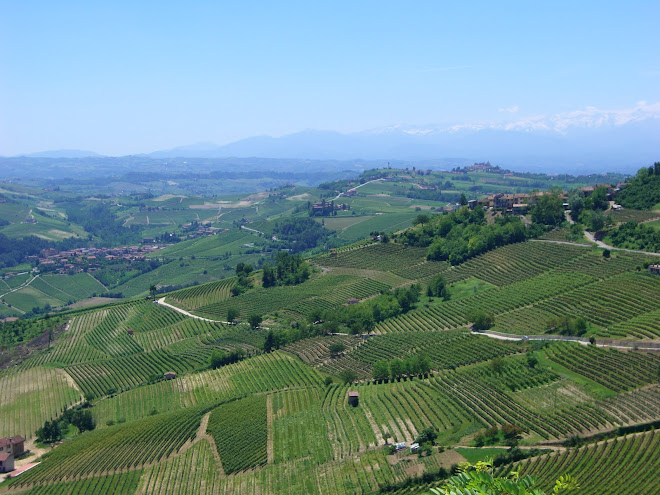
Walking further down the sloping north facing Avani vineyard, the soil transitioned from deep red volcanic clay near the winery, to a slatey, alluvial grey lower down. Davendra and Shashi shared with us the journey they have taken developing the winery and vineyard over the last 15 years. This included the ongoing process of rehabilitating the vineyard, transforming it gradually from a conventional winemaking operation to an organic and biodynamic one, dramatically reducing the cropping levels while increasing the vine density.

Shashi and Davendra were rightly proud of the positive impact organic and biodynamic farming practices were having on the health of the soil (and as we would find out later that morning, on the wines themselves). The soil was healthy: soft underfoot with lush grass and plant life nearby.

The Avani vineyard, 3/4 down, looking toward the winery
Shashi and Davendra are now 100% in control of the whole winemaking process, with the 2012 vintage being the first made exclusively on site. A vertical tasting of the 2009, 2011 and an in-barrel taste of the 2012 confirmed that the wines being produced at Avani are on the improve as the younger vines on the vineyard mature, and as the increasingly confident winemaking is honed and perfected.

As we both left the winery on the sunny spring morning, it was clear that the story of Avani was one that should appeal to the hearts, minds and palates of drinkers keen to try small output, hand-made, honest yet exciting wines.

Sunday, November 3, 2013

2012 Teusner Avatar (Barossa Valley)


This is such a good wine. I’ve had some superb Melton Nine Popes over the years but this might be the best Barossa GSM I’ve tried.  Grenache 40%, Shiraz 30% Mataro 30%.

Stick your nose into a glass of this and big smile is sure to follow. A beautiful bouquet that evolved over a couple of days with aromas of berries, florals, chocolate oak, five spice and orange peel. To drink it is eminently smashable but the quality and complexity on offer encourage you to savour and sip slowly. Juicy, pitch perfect ripeness, and with a long, savoury finish. Lovely chocolate, spice, and a stony minerality are the signature flavours. Can be found for around $30 and is worth every penny. Drink now or at anytime over the next decade.

Rated:


RRP: $35
ABV:14.5%
Closure: Screwcap
Drink: 2013-2022
Website: www.teusner.com.au


Red

Tuesday, October 29, 2013

2012 Mayer Close Planted Pinot Noir (Yarra Valley)


Gembrook Hill, PHI, and Hoddles Creek are my go to Yarra Pinots. Budget permitting I’m going to have to add Mayer to my list. Of course, Timo Mayer, the winemaker here is also part of the winemaking duo at Gembrook Hill.

It starts with a lovely perfumed nose with beautiful sweet cherry to the fore. Great to drink with generous, almost viscous dark cherry fruit. It nevertheless retains a lightness of feel, underpinned by a prominent acidity and some minerally notes. Latent complexity and length in spades. Very good now and likely great in 5 years or so.

Rated:
+


RRP: $55
ABV: 13.0%
Closure: Screwcap
Drink: 2015-2022+
Website: www.timomayer.com.au


Red

Wednesday, October 16, 2013

Thousand Minarets - RedtoBrown's gift to the wine world . . .


Growing up as kids there was a hill in Sydney we used to slide down on pieces of cardboard. That hill had a little patch with some Thompson seedless grapes growing wild. We’d have a nibble on these every now and then, and it was oft remarked how sweet and succulent these grapes were. These innocent beginnings were to lead to the greatness that has become Thousand Minarets.

25 years on from those cardboard rides, the hill was rediscovered, albeit in a run-down state. How would a vineyard go here? That was the question we posed to ourselves. The Thompson seedless still certainly tasted good and it was cheaper than buying a site that actually had pedigree. This was enough to see us purchase the hill and plant it to Cabernet and other Bordeaux varieties. Meanwhile that little patch of the Thompson seedless was to be retained and nurtured to add a certain je ne sais quoi to the vineyard.

We set about thinking of what wine we could make from this unique site and came up with Thousand Minarets. Brown explains, “There’s just so much inspiration out there at the moment. Whether it’s a Thousand Candles charging a premium price for a red wine with some non-descript white wine added, Parawa Estate charging $1100 for a wine produced from 5 year old vines, or Dave Powell flogging a $900 wine to fund $90,000 strip club benders, we’ve just had so much to draw from. At the end of the day, we settled on Thousand Minarets, which looks to bring the best elements of all those other wines into one”.

This lofty goal can only be underpinned by a special terroir. The hill itself is marked out by a unique buckshot gravel and a quaint little stream running through the middle of it. The stream can sometimes become a torrent when the stormwater drain at the top of the hill, an integral part of the Sydney sewer system, overflows. We think this only adds to the unique complexity of flavour the fruit displays. Some may call it funk.

The vineyard is hand tended. Hand pruned. And before being hand-picked, each bunch of grapes receives a gentle cupping. This cupping and picking only occurs on a crescent moon, after which the grapes are hand sorted by elves in the winery.

There is minimal winemaking. From vineyard straight to barrel. Frogs included. For oak treatment we bought the world’s most expensive Dominique Laurent oak, which leaks worse than an ALP cabinet meeting, but certainly helps justify the wine's price tag.

When assessing the overall cost of this labour of love, which was boldly looking to combine the best of Thousand Candles, Parawa Estate, and the Laird, we thought the best way to price our wine was simply to add the prices together. A clean $2,100 per bottle. We may not know our PHs from our P Diddys, but we know how to price a fine wine.

And where is my sample you may ask? Well this is the response Red gave, ”We refuse to have these wines regarded at a level below the finest red wines in the world. In blind tastings involving Masters of Wine, they have held their own or surpassed some of the iconic names, recognised by wine aficionados.” Or put another way, the wine is just going to Asian markets so no need to be giving you guys freebies, especially when we have an $2060 margin on each wine.


Thousand Minarets – taste the artifice

*Article embargoed in Australia until the first case is sold sight unseen on the Hong Kong market.


Blog Design by: Designer Blogs